


Shop now
Triphala is one of Ayurveda's most well-known traditional herbal formulations. Made from three fruits—Amalaki, Haritaki, and Bibhitaki—it has traditionally been associated with digestive and bowel wellness.
Today, Triphala is available in several forms, including powders, tablets, and capsules. But with so much information available online, it can be difficult to separate traditional use from exaggerated claims. Does Triphala really "detox" the entire body? Is taking more necessarily better? Are all Triphala capsules the same?
Let's look at some of the most common myths about Triphala capsules and what you should consider before choosing a product.
Myth vs Fact: Triphala
MYTH 1: "Triphala Detoxes Every Toxin From the Body"
FACT: This is an overstatement.
Triphala has a long history of traditional use in Ayurvedic practices associated with digestion and cleansing. However, this should not be interpreted as meaning that Triphala capsules can remove every "toxin" from the body.
The body already has natural systems for processing and eliminating waste, involving organs such as the liver and kidneys as well as the gastrointestinal tract.
A more appropriate way to describe Triphala is as a traditional Ayurvedic formulation associated with digestive and bowel wellness.
MYTH 2: "More Triphala Means Better Results"
FACT: More is not necessarily better.
Vanan Triphala Capsules are intended to be taken according to the recommended serving on the label: one capsule daily after breakfast.
Taking more than the recommended amount does not mean that you will obtain faster or greater benefits. Higher intake may also increase the likelihood of digestive discomfort in some individuals.
The sensible approach is simple: follow the recommended serving rather than increasing the amount on your own.
MYTH 3: "Triphala Is Only for Constipation"
FACT: Triphala has traditionally been used for more than occasional constipation.
Within Ayurveda, Triphala has been associated with digestive wellness, bowel regularity, and traditional cleansing practices. Modern research has also investigated Triphala for a range of potential applications, although the evidence varies depending on the specific preparation, dose, study design, and health outcome being investigated.
It is therefore better to view Triphala in the context of its traditional use and the available scientific evidence, rather than reducing it to a single purpose.
MYTH 4: "Triphala Can Replace My Medication"
FACT: It should not.
Triphala capsules are a dietary supplement and should not be used as a replacement for medicines prescribed by a healthcare professional.
If you take regular medication or are managing an ongoing health condition, speak with your doctor or pharmacist before adding a Triphala supplement to your routine.
MYTH 5: "All Triphala Capsules Are the Same"
FACT: They can be quite different.
Triphala products may contain whole-fruit powders, extracts, or combinations of different forms. Products can also vary in the proportion of Amla, Haritaki, and Bibhitaki, extract specifications, serving size, excipients, capsule material, and quality-control requirements.
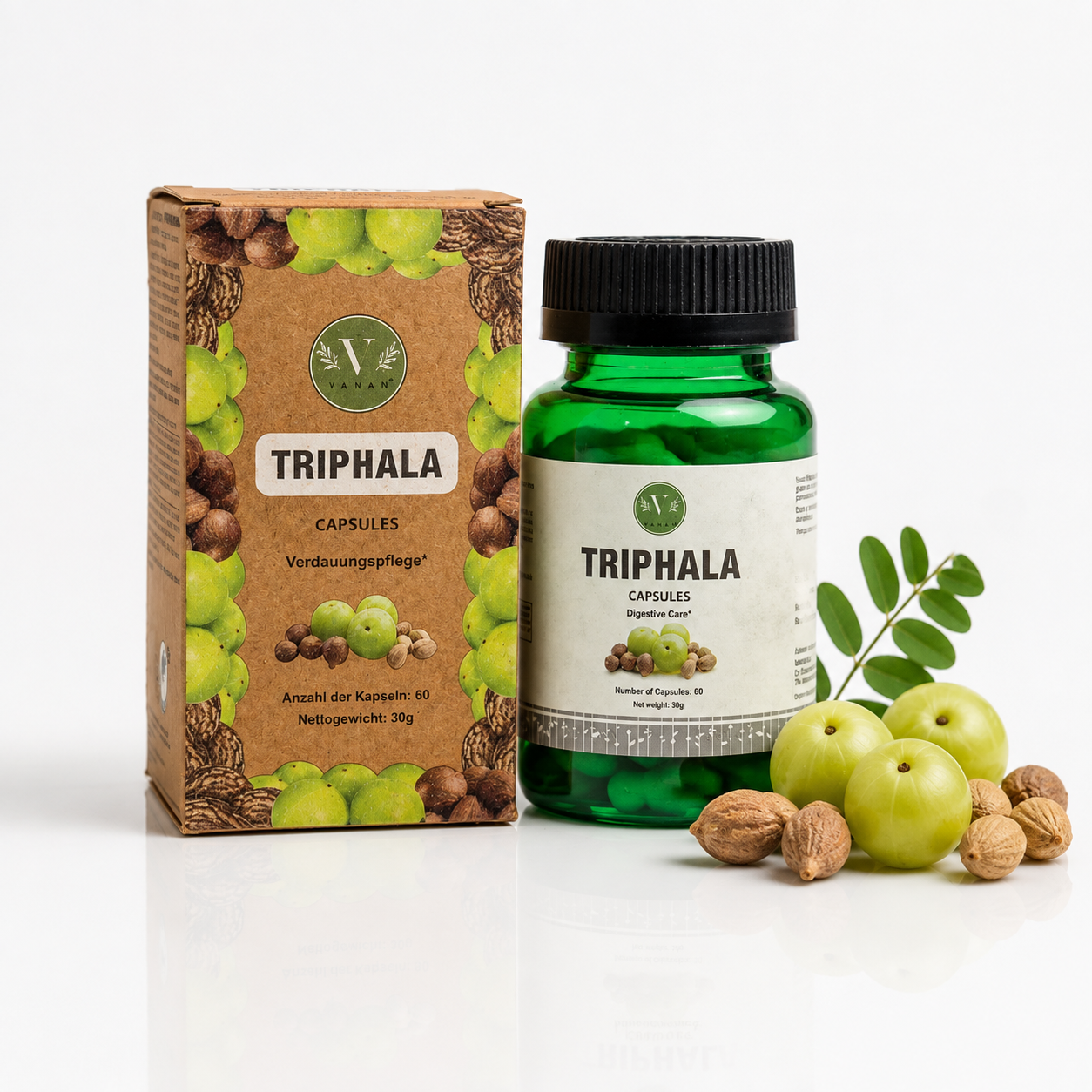
Vanan Triphala Capsules contain 300 mg of Triphala extract comprising Amla, Haritaki, and Bibhitaki extracts.
When comparing products, don't look only at the total milligram number on the front of the pack. Check which ingredients are present, whether the product contains powder or extract, the amount per serving, and the quality specifications.
MYTH 6: "Triphala Works Overnight"
FACT: There is no universal timeline for noticing an effect from a Triphala supplement.
Individual responses can vary depending on dietary habits, lifestyle, the specific preparation, serving size, and other factors.
Instead of expecting an immediate change, use the product according to its recommended serving and give your routine time to become consistent.
MYTH 7: "Capsules Are Less Effective Than Powder"
FACT: The form of the product does not, by itself, determine its quality or effectiveness.
Powder and extract capsules are different preparations. What matters is the identity, quality, composition, specifications, serving size, and manufacturing quality of the product.
Capsules also offer a convenient and measured format, making them easier to incorporate into a consistent routine.
So, when comparing a Triphala capsule with a powder, compare the actual formulation and specifications rather than assuming that one format is automatically better.
MYTH 8: "Ayurvedic Supplements Don't Need Quality Testing"
FACT: Traditional origin does not mean that quality testing is unnecessary.
A properly manufactured herbal product should have appropriate controls for identity, quality, purity, and consistency.
Vanan Triphala Capsules are manufactured in a GMP-certified facility and undergo appropriate quality-control testing. Where applicable, chromatographic techniques such as HPTLC can be used as part of herbal material and product evaluation.
When choosing a Triphala product, look for clear labelling, appropriate manufacturing standards, ingredient specifications, and evidence of quality control.
MYTH 9: "Triphala Is Only Relevant in India"
FACT: Triphala originated in the Ayurvedic tradition of India, where it continues to be widely known and used.
Its availability has also expanded into international supplement markets, where consumers may encounter Triphala in capsules, powders, and other formulations.
Its traditional origin remains important, but consumers today should also consider the quality, formulation, labelling, and intended use of the particular product they are purchasing.
How to Make Triphala Part of Your Wellness Routine
A supplement should complement, rather than replace, healthy lifestyle habits. A balanced diet, adequate fluid intake, regular physical activity, sufficient sleep, and a consistent daily routine all contribute to general wellness.
If you choose to use Triphala, follow the product's recommended serving rather than assuming that a higher intake will produce better results. For Vanan Herbal Triphala Capsules, the recommended serving is one capsule daily after breakfast, as stated on the product label.
Frequently Asked Questions
1. How many Vanan Triphala Capsules should I take?
The recommended serving is one capsule daily after breakfast, according to the product label.
2. Is Triphala a detox supplement?
Triphala has a long history of traditional use in Ayurvedic cleansing practices. However, "detox" should not be interpreted as a claim that Triphala removes every toxin from the body.
3. Can I take Triphala every day?
Follow the serving and directions provided on the product label. If you are pregnant or breastfeeding, taking medication, or managing a health condition, consult a qualified healthcare professional before using a supplement.
4. Is more Triphala better?
No. Taking more than the recommended serving does not necessarily provide greater benefits and may increase the possibility of digestive discomfort.
5. What should I check before buying Triphala capsules?
Look at more than the number of milligrams on the front of the pack. Check:
-
The form of Triphala used—powder or extract
-
The amounts of Amla, Haritaki, and Bibhitaki
-
The serving size
-
Ingredient specifications
-
Manufacturing standards
-
Quality-control information
-
Recommended usage and warnings
Final Thoughts
Triphala has a long history in Ayurveda, but that does not make every claim made about it automatically true. It is not a magic pill, an instant detox, or a replacement for prescribed medication. Product quality and responsible use matter just as much as the traditional ingredients themselves.
Vanan Herbal Triphala Capsules combine Amla, Haritaki, and Bibhitaki extracts in a convenient capsule format designed for daily use according to the product label. When choosing a Triphala supplement, look beyond the marketing claims. Understand what is actually in the capsule, how much you are taking, and what quality controls apply to the product.
Disclaimer:
This article is provided for educational purposes only and does not constitute medical advice. Triphala capsules are dietary supplements and are not intended to diagnose, treat, cure, or prevent any disease. Consult a qualified healthcare professional before using supplements if you are pregnant, breastfeeding, taking medication, or managing a health condition.


