


Shop now
Triphala is one of Ayurveda's best-known herbal formulations. The name comes from Sanskrit, where 'Tri' means 'three' and 'Phala' means 'fruits'. It combines three traditional fruits—Amla, Haritaki, and Bibhitaki—which have been used together in Ayurvedic practice for generations.
Triphala is available today as a powder, tablet, or capsule. These formats are not necessarily interchangeable because the amount of raw botanical material, extraction process, and composition can vary between products. Understanding the ingredients and form of the product can therefore help consumers make informed choices.
What Are the Triphala Ingredients?
Traditionally, Triphala is made from the dried fruits of Amla (Phyllanthus emblica), Haritaki (Terminalia chebula), and Bibhitaki (Terminalia bellirica). Ayurvedic texts describe Triphala as a traditional three-fruit formulation with a long history of use.
Modern researchers have studied Triphala and its individual fruits, including their phytochemical composition and biological properties. Much of the available evidence comes from laboratory research, animal studies, traditional use, or smaller human studies. These findings provide scientific background but should not automatically be interpreted as proof that Triphala treats a disease.
1. Amla: The Antioxidant-Rich Indian Gooseberry
Amla, sometimes called Indian gooseberry or Amalaki, is the fruit of Phyllanthus emblica. It grows across India and Southeast Asia and is known for its sour and slightly bitter taste.
Amla contains naturally occurring vitamin C, polyphenols, tannins, and other plant compounds. These constituents have been investigated in nutritional and botanical research, including research into antioxidant properties. Within Triphala, amla contributes one part of the traditional three-fruit formulation.
2. Haritaki: A Traditional Triphala Fruit
Haritaki is the fruit of Terminalia chebula and is also known as Harad or Chebulic myrobalan. It has a long history of use in Ayurveda and other South Asian traditional systems.
Haritaki contains tannins and naturally occurring compounds such as chebulic acid, chebulagic acid, chebulinic acid, gallic acid, and ellagic acid. Researchers continue to investigate these constituents and different Haritaki preparations. Haritaki is recognised as one of the three key ingredients in the traditional Triphala formulation.
3. Bibhitaki: The Third Fruit of Triphala
Bibhitaki is the fruit of Terminalia bellirica and is also known as Baheda or Vibhitaki. It is found across the Indian subcontinent and parts of South and Southeast Asia.
Research has investigated Bibhitaki and its naturally occurring compounds, including tannins and other phytochemicals. Much of the evidence concerns laboratory or experimental research and should be interpreted accordingly. Within Triphala, Bibhitaki completes the traditional three-fruit formulation alongside Amla and Haritaki.
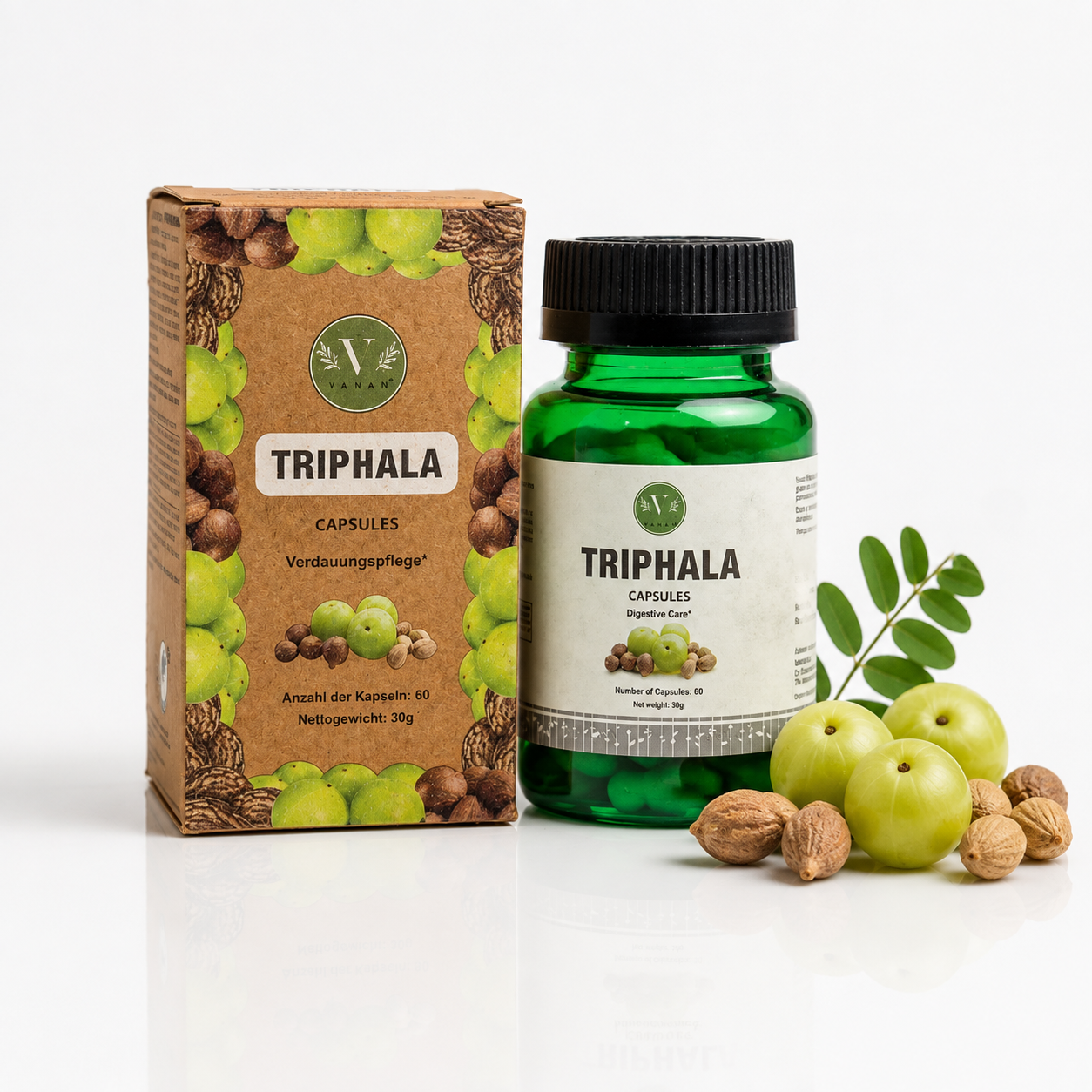
Why Choose Vanan Triphala Capsules?
Vanan Triphala Capsules provide the three traditional Triphala fruits in a convenient plant-based capsule format. Each capsule contains a defined amount of amla, haritaki, and bibhitaki extracts.
Ingredient |
Amount per capsule |
Role in Formula |
|
Amla extract |
100 mg |
One of the three traditional Triphala fruits. |
|
Haritaki extract |
100 mg |
One of the three traditional Triphala fruits. |
|
Bibhitaki extract |
100 mg |
One of the three traditional Triphala fruits. |
|
Total Triphala extract |
300 mg |
Traditional Ayurvedic three-fruit botanical blend. |
|
HPMC capsule shell |
Plant-based |
Plant-based capsule format. |
The formula contains the three Triphala extracts in a plant-based HPMC capsule shell. Product composition and quality attributes should always be confirmed against the current product specification and label.
Triphala Extract vs Triphala Powder
Triphala powder is traditionally prepared from dried fruits that are cleaned, dried and powdered. Triphala extract is prepared through an extraction process that concentrates selected botanical constituents from the fruits.
Because powder and extract are prepared differently, they should not be compared on a weight-for-weight basis. The form of the ingredient, processing method, and quality controls all contribute to the final product.
Vanan Triphala Capsules contain 300 mg of Triphala extract, providing a convenient capsule format for daily use.
Quality and Product Information
For botanical products, appropriate raw-material identification, controlled processing, and quality testing are important considerations. Consumers should look for clear information about the botanical ingredients, amount per serving, dosage instructions, and applicable quality controls.
Vanan Triphala Capsules provide 300 mg of Triphala extract in a plant-based capsule format. The product information, certifications, and testing claims should be considered according to the current product documentation and applicable market requirements.
Clinical Evaluation of Vanan Triphala Capsules
The finished Vanan Triphala Capsules were evaluated in a 30-day open-label clinical study registered with the Clinical Trials Registry–India. The study involved 35 adults with constipation-predominant Irritable Bowel Syndrome (IBS-C).
The study assessed symptom scores, spontaneous bowel movements and quality-of-life measures during the evaluation period.
The findings provide product-specific information from the population and study duration evaluated. As an open-label, single-arm study involving a limited number of participants, the results should be interpreted in the context of the study design and should not be considered evidence that the product will produce the same outcomes for every individual.
A Simple Daily Botanical Routine
The capsule format provides a measured way to include Triphala extract in a daily routine. Vanan Herbal Triphala Capsules are recommended as one capsule daily after breakfast, according to the product directions.
Follow the recommended serving size and usage instructions provided on the product label. A balanced diet, adequate hydration, regular physical activity, and appropriate healthcare guidance remain important for overall wellbeing.
Frequently Asked Questions
1. What are the three ingredients in Triphala?
The three traditional ingredients are Amla, Haritaki and Bibhitaki—scientifically known as Phyllanthus emblica, Terminalia chebula and Terminalia bellirica.
2. What is Amla?
Amla is the fruit of Phyllanthus emblica and one of the three traditional fruits used in Triphala. It contains naturally occurring vitamin C, polyphenols and other plant compounds.
3. What is the role of Haritaki in Triphala?
Haritaki is the fruit of Terminalia chebula and one of the three traditional Triphala fruits. It contains tannins and other naturally occurring plant compounds that continue to be studied.
4. Is Bibhitaki the same as Baheda?
Yes. Bibhitaki, Baheda, and Vibhitaki are traditional names associated with the fruit of Terminalia bellirica.
5. How much Triphala extract is in Vanan Herbal's capsule?
Each capsule contains 300 mg of Triphala extract: 100 mg Amla, 100 mg Haritaki, and 100 mg Bibhitaki.
6. How should Vanan Triphala Capsules be taken?
The product directions recommend one capsule daily after breakfast. Always follow the current product label. If you are pregnant or breastfeeding, take medication or have a medical condition, consult a qualified healthcare professional before using any supplement.
7. What is the difference between triphala extract and triphala powder?
Triphala powder is made from dried fruits, while triphala extract is prepared through an extraction process. These are different botanical preparations and should not be compared on a weight-for-weight basis.
Final Thoughts
Triphala brings together three traditional Ayurvedic fruits—Amla, Haritaki and Bibhitaki—in a single botanical formulation. Traditional use provides historical context, while modern research continues to investigate Triphala and its individual ingredients.
Vanan Triphala Capsules provide 300 mg of Triphala extract in a convenient plant-based capsule format. The finished product has also been evaluated in a 30-day clinical study involving adults with IBS-C, providing product-specific clinical information from the study population and evaluation period.
As with any botanical supplement, individual responses may vary. A balanced diet, adequate hydration, regular physical activity, and appropriate healthcare guidance remain important for overall wellbeing.
Disclaimer
This article is provided for general educational and informational purposes only and is not intended to constitute medical advice. Triphala is a traditional Ayurvedic botanical formulation, and this product is not intended to diagnose, treat, cure, or prevent any disease.
The clinical information mentioned in this article relates specifically to the Vanan Triphala Capsules evaluated in the stated clinical study and should not be interpreted as establishing the product as a treatment for IBS, constipation, or any other medical condition. Individual responses may vary.
If you are pregnant or breastfeeding, have a medical condition, or take prescription medication, consult a qualified healthcare professional before using this product. Always follow the recommended serving size and usage instructions provided on the product label.


